Our fight against the Russian disease
This article was written on the anniversary of the full-scale invasion for Weekendavisen, one of Denmark's most influential analytical publications, which is also read in other Scandinavian countries.



One of the archival videos from Ukrainian television I recently watched showed Ukraine destroying its long-range strategic bomber, the Tu-22M3, at a regional military airport in the early 2000s under the U.S. Department of Defense’s supervision. It was part of the deal following the Budapest Memorandum, signed in 1994, in which Ukraine agreed to give up its nuclear arsenal in exchange for security guarantees from the United States, the United Kingdom, and Russia.
Obviously, the Budapest Memorandum did not work. But honestly, Ukraine had very few realistic options but to sign it back then. Still, this is exactly why Ukrainians have every right to ask for support from the US and the UK.
Russia’s war against Ukraine has lasted 12 years, four of them as a full-scale invasion. For people like me, those born into a generation that knew war only through our grandparents’ memories of the Second World War, it has taken time to accept that this is not temporary.
The last year brought something new. With Donald Trump in the White House, the U.S. shifted from an ally to a mediator in the so-called peace talks. There has been hardly any serious signal from the Kremlin that it is ready to stop. The clearest sign would be a ceasefire, but that is not part of the talks. The process looks more like a business arrangement between the United States and Russia than the pursuit of a just peace.
A year ago I listened to U.S. Vice President JD Vance’s speech, at the Munich Security Conference, in which he alienated European allies. On the sidelines the Ukrainian and American delegations discussed a bizarre deal on raw minerals that never came into effect. A bit later, the ill-fated Oval Office meeting between Volodymyr Zelenskyy and Donald Trump took place.
More consequential was the March 3, 2025, decision by the U.S. administration to abruptly suspend military aid and intelligence sharing for about a week. That pause allowed Russian forces, reinforced by North Korean troops, to push Ukrainians out of the Kursk region, which had served as a buffer against strikes on Ukrainian territory.
Withholding aid became leverage – a cudgel to push Kyiv into talks on Russian terms.
Ukraine understood it needed to build the capacity to defend itself with homegrown technologies back in 2023, when the U.S. Congress delayed aid for months. Through mass drone production and new tactics, it achieved frontline parity. But it still could not defend its own skies from Kremlin bombardment. American-made Patriot systems proved to be the only effective tool against ballistic missiles.
A year ago, we feared air-defense systems would be depleted within months as Moscow intensified attacks and drained stockpiles. I focused on one question: what does the U.S. provide that cannot be replaced? I spoke with senior officials in several capitals, including Stockholm and Helsinki, who handled military and civilian aid to Ukraine. European allies were ready to purchase systems, but U.S. approval was required. That arrangement saved thousands of lives. Yet we understood that Washington could remotely restrict their use, retaining control over software updates and radar configurations essential to Patriot operations.
Norwegian Advanced Surface-to-Air Missile Systems (NASAMS) are also capable protect cities from aircraft, cruise missiles, and drones. But they also rely on American missiles and radars. F-16 Fighting Falcons may be used as air defense interceptors. But all of those options indeed were costly.
Before, when Moscow was sending dozens of rockets and drones, Ukraine was shooting down most of them. But the Kremlin was adding more to exhaust air defenses. As an example, in summer, on July 4–5, Russia deployed 539 drones and 11 missiles. It injured 26 civilians, including children, and damaged schools and homes. On July 9, another wave of 728 drones and decoys, along with 11 missiles, struck Kyiv and ten other regions. At least ten civilians have died in such strikes this summer.
Each ballistic or supersonic missile costs between $1 million and $7–8 million. The effect is devastating because the strikes were followed by large waves of drones, including decoys, making interception far harder. The Iranian-designed Shahed drones were exported to Russia for up to $200,000.
By 2025, Moscow developed its own technology, transforming Shaheds into similar drones, called Geran. Their production expanded at the Alabuga Drone Factory in Tatarstan, and the price reportedly fell to $50,000. Upgraded versions with improved electronics, navigation, and warheads cost $70,000–$80,000. The drop came from localization, though engines, processors, and videocameras remain Chinese. Russia also recruited cheap labor from several African countries to assemble drones in Alabuga.
A cheaper drone, the Gerbera, was developed as a decoy. It usually carries no real warhead or only a small charge. They are launched alongside fewer real Shaheds, often in the first wave. If interceptors target them, explosive-laden drones continue.
Ukraine began developing interceptor drones to shoot down Shaheds. Some cost $5,000. Later, more companies joined, producing models for about $1,100.
In September, Russia attacked Poland with 19 drones, making headlines. Among them there were Gerbera decoys, which cost $15,000. Backed by NATO Poland shot down three to four drones using fighter jets with air-to-air missiles. The cost imbalance was stark: each interceptor missile costs hundreds of thousands of dollars. A day before the attack, at the Ukrainian factory, I saw their interceptors for $1,500.
Ukrainian authorities said most of the original wave — 70 drones — was intercepted by the Ukrainian air defense before reaching Polish airspace.
Officials and military experts often admitted that European investment in Ukrainian miltech was crucial. In April 2024, Denmark became the first country to purchase weapons for Ukraine directly from Ukrainian manufacturers, for $28.5 million. The “Danish model,” as it is now called in Ukraine, where a country invests directly in Ukraine’s defense industry, proved a way forward.
Counter-drone solutions indeed save lives every day; more could be done with stronger support. Still, in the year of negotiations, civilian casualties in Kyiv were four times higher than in the years before.
In 2025, Russia attacked Ukraine’s energy system more than 4,500 times. But to completely disable thermal power plants, Russia needed sustained cold, weeks of below-zero temperatures. For the past decade, Ukraine’s winters had been unusually warm.
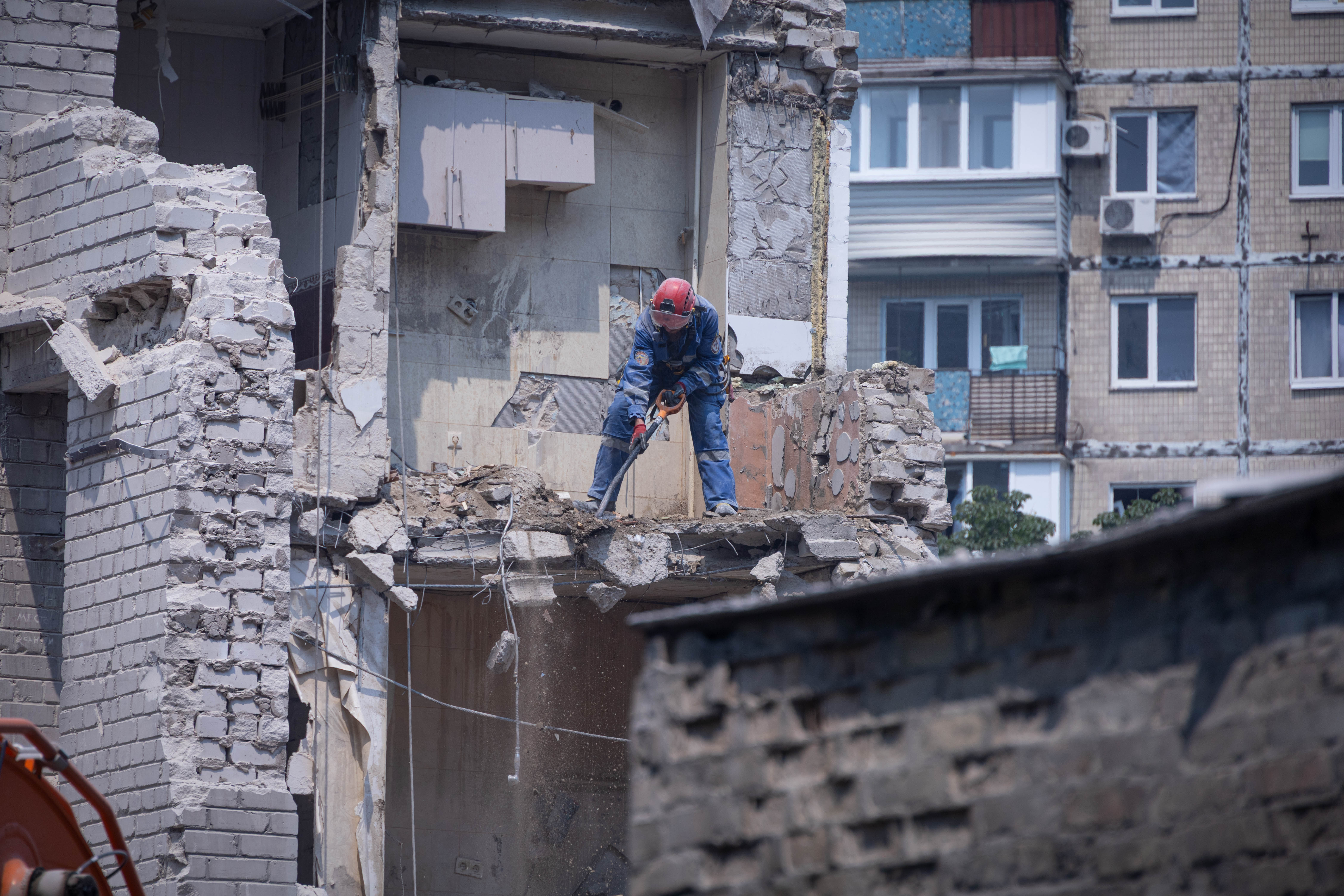
This winter, Russia got what it wanted. Over recent months, temperatures in Ukrainian cities fell to –20 to –26°C. Thermal power plants supplying heat to millions in major cities came under massive, targeted attacks. Some facilities were completely disabled, with no clear timeline for restoration. Strikes also hit residential buildings, kindergartens, hospitals, and businesses. Medics, firefighters, and utility workers were attacked during rescue operations. The Ukrainian Ministry of Internal Affairs recorded more than 60 attacks on rescue workers in the last three months of 2025 alone. Five were killed, and over 30 were wounded.
To grasp the cruelty of these deliberate strikes, it is enough to examine just one in detail.
On the night of January 9, 2026, freezing rain fell across much of Ukraine. Roads, sidewalks, and power lines iced over before our eyes. That night, Russia fired 36 missiles and 242 drones across the country, and targeting the capital, leaving half a million residents without electricity.
My team was collecting testimonies from war crimes survivors and filming a documentary about rescue workers in Kyiv.
“Snizhana, here’s what came this time,” Vitaliy Kachuro, State Emergency Service worker, told his wife in a video. A high-rise was burning after a Russian Shahed drone hit the building, located about 20 minutes from the thermal power plant that heats much of that part of the city
Whenever Vitaliy was on a call, he recorded a video to reassure his wife that he was safe. Snizhana received the message at 01:55. At 02:55, Vitalii stopped responding. In the morning, the State Emergency Service called. “I only asked: is he alive?”
Vitaliy was in critical condition in intensive care, among five rescuers and four medics injured in a repeat attack at the site. His colleague, 36-year-old Oleksandr Zibrov, died in hospital from his injuries.
On his first day in the hospital, Vitali's heart stopped twice. Shrapnel from the second Shahed strike caused internal bleeding, fractured vertebral arches, and a displaced spine. He suffered a closed traumatic brain injury.
Vitaliy is a father of three: the youngest is three months old, the second two are two years old, and their daughter is six. When the situation in Kyiv worsened a few months before winter, his wife urged him to leave with the family and go abroad. With three children, he had the right to do so. The man refused: “I won’t abandon my work.”
A different strike on the very same day killed 56-year-old paramedic Serhiy Smoliak. The medical team was preparing to leave when another drone hit the yard of the shelled building. Four more colleagues were wounded. This canbe considered a double strike – a grave violation of international humanitarian law.
Serhiy moved to Kyiv from Kakhovka, where he had worked as a senior paramedic for over 25 years. Kakhovka was occupied during the first days of the full-scale invasion, and Smoliak's family left in autumn 2022, as Russian forces were systematically persecuting and abducting residents. In October 2022, they illegally detained Serhiy’s nephew, a local anesthetist and an operating room nurse at the city hospital, a family friend said.
Serhiy was one of more than 300 medics killed since the full-scale invasion, amid over 2,000 documented attacks on healthcare facilities in Ukraine, according to Physicians for Human Rights.
Russia’s war crimes are not collateral damage but a method of warfare. In 2024, the International Criminal Court issued arrest warrants for senior Russian military leaders, accusing them of directing attacks against civilian objects and committing crimes against humanity. The ICC’s 125 member states are obliged to detain and transfer any indicted individuals who enter their territory.
That’s why it was painful for Ukrainians to see Vladimir Putin welcomed in Alaska, emerging from isolation as the attacks continued.
To be clear, the destruction of Ukraine is fully the Kremlin’s responsibility. The United States bears none. Still, some losses might have been avoided. I remember reporting from the frontline during one round of the U.S.–Russia talks and speaking with Ukrainian soldiers. “Imagine your friend is sick and in pain, and you have the pill that could help him—but you don’t share it,” the soldier said.
It is not only about supplying air-defense missiles. At this year’s Munich Security Conference, a side event addressed the destruction of Ukraine’s energy system. The CEO of a major energy company said the grid is almost destroyed, and Ukraine relies largely on nuclear power. To secure rebuilding so Ukrainians won’t freeze in winter 2027, orders must be placed by May. When I asked what air defense was needed to protect the energy infrastructure, experts were clear: it is also about deterrence. Ukraine needs long-range weapons to strike the launch platforms Russia uses.
At a Ukrainian lunch at the same conference, Danish Prime Minister Mette Frederiksen was among the few who spoke not just about managing the crisis, but about allowing Ukraine to use Western weapons to strike back.
The current reality suggests Ukraine is living through what may be the weakest American presidency of this period. Russia once calibrated its actions. There was no real deterrence, but there were limits. If Moscow went too far — such as striking critical infrastructure — there was at least some risk of retaliation. Now Vladimir Putin knows his hands are not tied.
For me, the key question was whether European powers had assessed what they could do on their own. Things have improved. Europeans are taking sovereignty more seriously. Americans brag that this happened under U.S. pressure, which is partly true. But one detail worried me. In recent addresses, President Volodymyr Zelenskyy said the United States, despite earlier promises, has still not issued licenses to produce Patriot air-defense missiles in Europe. That shows it is not only about NATO members spending 5 percent of GDP.
Unable to win on the battlefield, Russia has tried to subdue the West. It may have succeeded with the U.S. president, but not elsewhere. At the same venue, I spoke with former Estonian President Kersti Kaljulaid, who used a stark metaphor: the Nordic countries are like the largest piece of ice—the biggest floe to climb onto as the ice breaks around us.
Ukraine, meanwhile, by strengthening itself, is working to become a country that cannot be swallowed. Many Ukrainians see this war as hard labor: the daily work of keeping life bearable, like fighting a serious illness. You cannot ignore it, otherwise the risk of death rises. In its fourth year, Ukraine is more exhausted but also more hardened and more aware of its growing capacity to protect its people, even as the Kremlin works to fracture the Western front.
Additional reporting by Kseniia Savoskina, Oleh Baturin